
As the nation continues to commemorate its 250th anniversary, a new documentary turns its attention to the city at the center of the American experiment — Washington, D.C.
“The Capital,” a documentary series presented by the Institute of Politics, Policy and History (IPPH), explores how Washington became the permanent seat of the federal government, who helped build it and how the city’s complicated history reflects the continuing American story.
At a recent premiere at the Smithsonian’s Hirshhorn Museum, former D.C. Mayor Sharon Pratt, founding director of IPPH, said the strong turnout of more than 250 guests demonstrated an interest in understanding the history and evolution of the nation’s capital.
“We are really thrilled at IPPH that we’re getting such a turnout,” Pratt said, adding that people care about the nation’s capital and how it was created. The Smithsonian’s participation in the September premiere also gave the event special significance, she said.

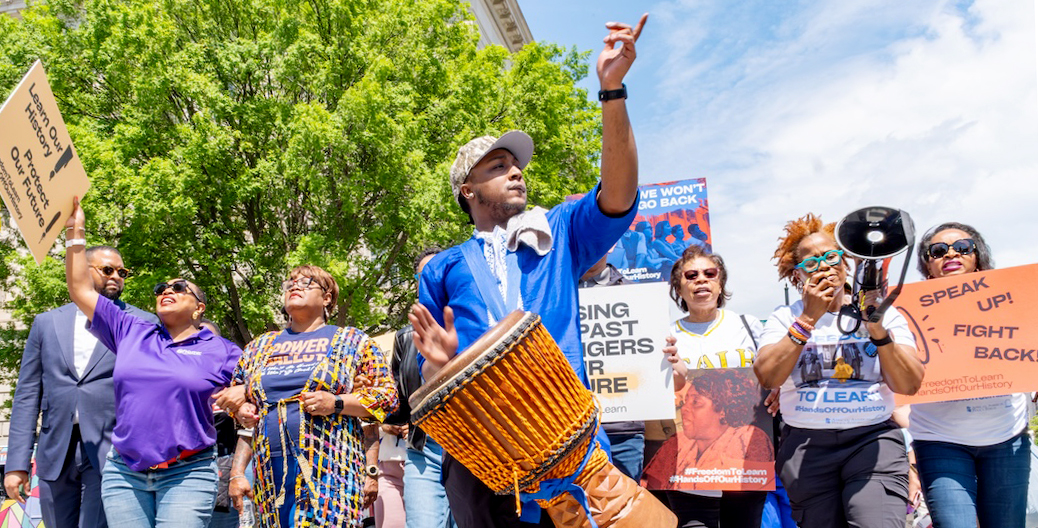
Speakers described the capital as a place of democratic innovation, protest, struggle and resilience. Its history includes the British attack on Washington during the War of 1812, the Civil War, the suffrage movement, the 1963 March on Washington and generations of demonstrations in which Americans traveled to the capital to demand that the country live up to its democratic promises.
What’s more, the timing of the documentary is intentional.
Pratt said IPPH wanted the project completed for America’s 250th anniversary, so a national celebration of independence and democracy would include the history of the city where the institutions of American democracy are centered.
“You can’t tell the American story without telling the story of Washington, D.C.,” said the District’s first woman leader. “You can’t grasp the notion of a nation that had this unique concept of government of ‘we the people’ without understanding the role of the capital.”
Taking D.C.’s History Into the Community
For IPPH, the premiere is not intended to be the end of the project.
Pratt said the organization hopes to take the documentary into local communities, accompanied by scholars who can answer questions and help residents learn more about how Washington was created and built.
That history includes not only presidents, politicians and architects, but the physical labor behind it. Pratt noted, for example, the enormous effort required to transport massive stones from Virginia to Jenkins Hill, where the Capitol was built.
Dr. Joy G. Kinard, a scholar associated with the Smithsonian’s Anacostia Community Museum and National Museum of American History, also expressed hope that the documentary would become an educational resource for teaching D.C. history, including at institutions such as the University of the District of Columbia.
“The future of [preservation] is to invest in it, learn how to cultivate what we have done in the past and how it needs to be cultivated [for the future],” Kinard said in a 2023 interview with award-winning cultural preservationist Monica Rhodes. “We still need to do the oral histories, we still need to publish, we still need to have the readings face-to-face in the community … there’s more work.”
For Pratt, the broader goal is to ensure that Washingtonians — and Americans — understand that the District is more than the backdrop for national politics.
Rather than being understood as a multidimensional place, “we are often just the piñata in a political ad,” she said.
“The Capital” is now available on WETA Plus, the PBS app and WETA’s YouTube channel. Six individual episodes will also air as interstitial segments on WETA PBS and Metro channels, directing viewers to the complete series. The documentary is scheduled to remain available through WETA for two years.
As America observes its 250th anniversary, the former D.C. mayor hopes the documentary will encourage viewers to see Washington not merely as the place where the nation is governed, but as a community whose history is inseparable from the history of the country.
“Our stories need to be told,” she said, “because they are thoroughly American stories.”