


SciCheck Digest
Experts agree mammograms are the best tool to screen for breast cancer and that the benefits of the exam outweigh the risks. But a video in Spanish recommended that women over 40 skip mammograms, claiming the test is “unsafe” and “unnecessary.”
Full Story
Breast cancer is the second leading cause of cancer death in women in the United States. About 300,000 women will be diagnosed with breast cancer in 2023, and about 43,000 women will die from the disease this year, according to estimates by the American Cancer Society.

Expert groups agree that mammograms, or X-ray images of the breasts, can prevent some breast cancer deaths. Even though they have limitations, as we’ve explained, mammograms are the most effective tool available for looking for signs of breast cancer before a person has any symptoms. Mammograms allow for early detection and early treatment for breast cancer, which can increase the chances of survival from the disease.
“Mammography is the only test that is proven to save lives,” Dr. Sarah M. Friedewald, chief of breast imaging and associate professor of radiology at Northwestern University Feinberg School of Medicine, told us about breast cancer screening methods in a phone interview.
Both the American College of Radiology and the Society of Breast Imaging say mammograms can reduce breast cancer mortality if women with average risk for the disease begin getting annual mammograms at age 40.
In May, the U.S. Preventive Services Task Force, an independent panel of national experts in disease prevention, issued a draft of its updated guidance urging women at average risk of breast cancer to get a mammogram every other year between the ages of 40 and 74. Previously, the group had recommended women start biennial mammograms at age 50, and it said women in their 40s could choose to get mammograms, in consultation with their doctors.
The guidelines do not pertain to higher-risk women, who usually are told to begin screening sooner than age 40. Other expert groups differ on exactly how frequent mammograms should be and when women should start, but there is broad consensus that regular mammograms are valuable for middle-aged to older women.
“A rigorous review of the most up-to-date, high-quality scientific evidence clearly shows that mammograms are beneficial and can help keep women from dying of breast cancer,” Dr. John B. Wong, a professor at Tufts University School of Medicine and a member of the task force, told us in an email.
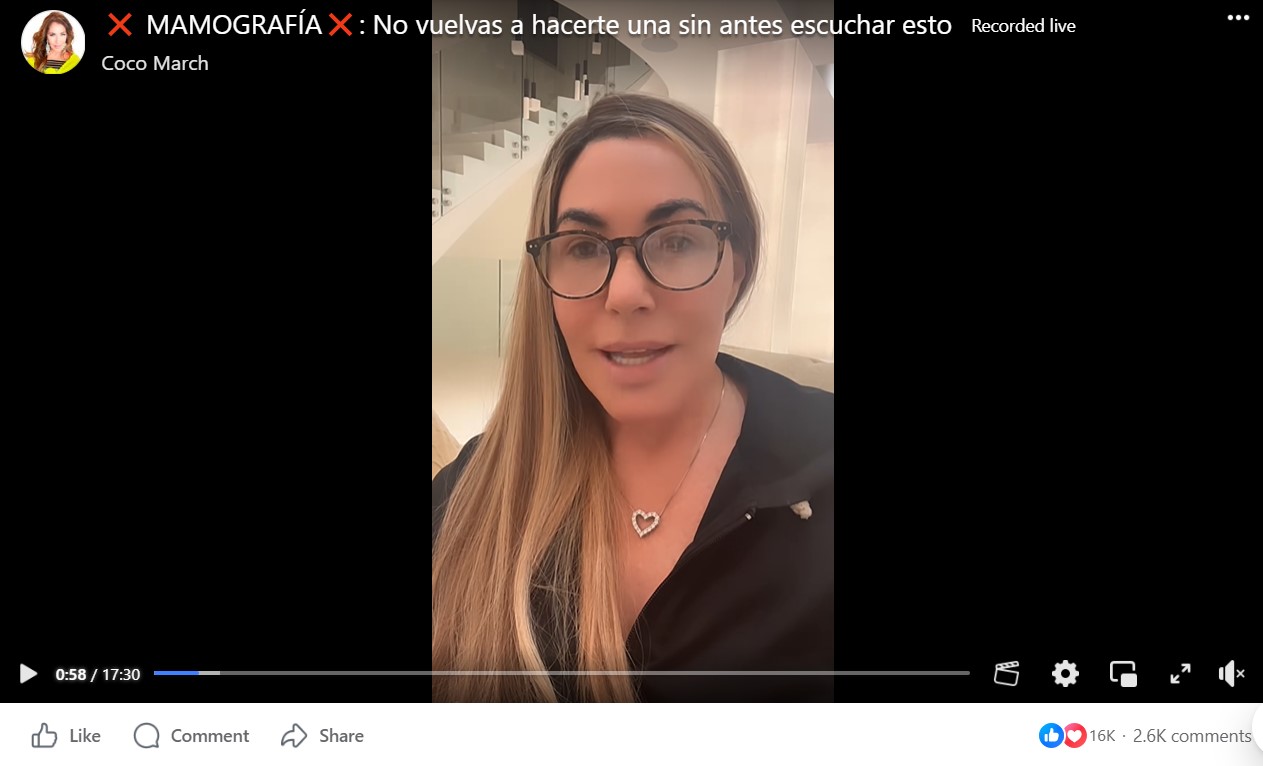
Yet, in a viral video in Spanish, a woman claimed the benefits of mammograms do not outweigh the risks and recommends that women skip them, counter to the consensus in the medical community.
“There is scientific evidence that mammograms are unsafe, unnecessary, and create completely unnecessary risk and anxiety for any woman,” said Coco March in a Facebook Live video that is now unavailable, but had over 500,000 views in one day. Neither of the two articles she presented in the video as evidence back up her claims, as we will explain.
Mammograms use low and safe radiation doses. The American Cancer Society says a woman would typically get the same amount of radiation used in a mammogram from her natural surroundings in about seven weeks.
In her 17-minute-long video, March, who uses several social media accounts to promote natural products she sells online, advised women over 40 to avoid mammograms and instead prevent breast cancer by getting ultrasounds and taking vitamins and other supplements.
Ultrasounds, she incorrectly claimed, are “the most accurate exam you can get.” March has made misleading claims about mammograms and other health issues before. In the video, she incorrectly added that “studies have shown” that doing a breast self-exam “is much more accurate than mammography.”
Dr. Claudia Tellez, an oncologist working with Spanish-speaking patients at the Lurie Cancer Center Hispanic Breast Cancer Clinic at Northwestern Memorial Hospital, said March’s comments are “very dangerous and incorrect.”
“It’s been very well documented that the improvement in survival is correlated with mammogram technology, so to tell people not to do their mammograms is truly criminal,” Tellez told us in a phone interview.
Benefits of Mammograms Outweigh Risks
As we said, mammograms are not perfect. The exam has limitations, and it can have some risks.
One of the risks is that a mammogram result may look abnormal even if there is no cancer in the breast. A false-positive result can lead to anxiety and creates the need for further testing, which can cost time and money. According to the National Cancer Institute, 1 of every 10 women having a mammogram will have a false-positive result.
Mammograms can also show false-negative results, which is when the test misses a cancer. Data from the National Cancer Institute estimate 1 in 5 cancers are missed by mammography. This occurs more commonly in younger women, women with dense breast tissue and women who have specific kinds of cancers.
Mammograms can also find cancers that may not be dangerous. Overdiagnosis can lead to unneeded treatment, University of Illinois Cancer Center experts Dr. Pamela Ganschow and Yamilé Molina told us, because no available tests are very good at predicting “which breast cancers will or will not progress or become harmful.”
“Therefore, all women diagnosed with breast cancer currently need to undergo treatment,” they added.
One of the articles presented as “evidence” in March’s video highlights some of these potential risks to misleadingly claim mammograms are “harmful and should be avoided.” The 2015 article was written by a single researcher, a former leader of the Nordic Cochrane Center, who also opposes COVID-19 vaccination.
Wong, from the U.S. Preventive Services Task Force, told us that in the course of drafting its latest recommendation, the USPSTF carefully reviewed the potential harms and benefits of mammography.
“If you balance the potential harms of screening, including the minimal radiation exposure from mammograms, against the proven benefit of preventing people from dying of breast cancer, it’s clear that the benefits of mammograms outweigh the harms, which is why the USPSTF recommends all women begin getting mammograms when they turn 40,” he wrote.
Ultrasounds and Self-Exams Don’t Replace Mammograms
March incorrectly claimed ultrasounds are better breast cancer screening tools than mammograms. As evidence, she shared an small study published in 2009 that compared the accuracy of both technologies in about 550 women in Kosovo. But all the women already had breast cancer symptoms, meaning the exams were not used for screening purposes.
Ultrasounds and mammograms complement each other. Ultrasounds, which use high-frequency sound waves to create images of the inside of the breasts, can show things that are harder to see in a mammogram. For example, they can distinguish between fluid-filled cysts and solid masses, the latter of which are more likely to be cancers. But mammograms can also show abnormalities that an ultrasound could miss, such as a microcalcification — one of the earliest signs of breast cancer.
“They actually really work together. It’s very hard to interpret an ultrasound without having the mammogram,” Friedewald, the radiology professor at Northwestern University, told us.
Tellez, the Northwestern University oncologist, agreed. Ultrasounds are helpful in assessing things a mammogram is showing or to guide a biopsy, she said, “but not in replacing the mammogram.”
Friedewald said MRI, or magnetic resonance imaging, is used as a supplemental screening for women with dense breast tissue. But this exam is not perfect either, as it can also miss some cancers and produce false-positives, according to the ACS. In its latest recommendation, the USPSTF says there is not enough evidence on the benefit of adding supplemental screening such as ultrasounds or MRI in women with dense breasts.
Studies do not show that self-examination is “much more accurate than mammography,” as March claimed, either. Although experts encourage women to be familiar with their breasts and to report any changes to a doctor, studies have not found a clear benefit from self-exams or breast exams made in a clinic, the ACS says.
Tellez said self-examination can be helpful, particularly if women learn how to do them well, but “it’s never a replacement” for getting regular mammograms.
Mammogram Screening in Hispanic and Latino Women
Social media posts that spread fear and misinformation about mammograms can be particularly dangerous for Hispanic and Latino women, Tellez told us. Cancer statistics show that Hispanic women have lower rates of breast cancer than women of other races or ethnicities. But Tellez said that when Hispanic women are diagnosed, they are usually at a more advanced stage of the disease.
That’s partly because, as with Black women, Hispanic women are more likely than non-Hispanic white women to develop triple-negative breast cancer, a fast-growing invasive breast cancer, she said. But also because of multiple barriers that make them less likely to get a mammogram, including language, access to health care, lack of time out of work, or fear of technology and radiation. Videos like March’s, Tellez said, feed into that fear and reinforce the false idea that it’s OK not to get a mammogram.
“So instead of cancer being diagnosed at stage zero or stage one, which are the cancers that are most highly curable, they’re presenting with stages two and three,” Tellez said.
Breast cancer is the leading cause of cancer death among Hispanic women in the U.S., according to the Centers for Disease Control and Prevention.
Clarification, Nov. 6: We clarified that the USPSTF prior guidelines said women in their 40s could decide to begin mammogram screenings in consultation with their doctors.
Editor’s note: SciCheck’s articles providing accurate health information and correcting health misinformation are made possible by a grant from the Robert Wood Johnson Foundation. The foundation has no control over FactCheck.org’s editorial decisions, and the views expressed in our articles do not necessarily reflect the views of the foundation.
Sources
Breast. Cancer Statistics Center. American Cancer Society. Accessed 31 Oct 2023.
Monticciolo, Debra L., et al. “Breast Cancer Screening Recommendations Inclusive of All Women at Average Risk: Update from the ACR and Society of Breast Imaging.” Journal of the American College of Radiology. 18 Jun 2021.
Breast Cancer: Screening. Draft Recommendation Statement. U.S. Preventive Services Task Force. 9 May 2023.
Mammography. FDA. Updated 21 Sep 2023, accessed 31 Oct 2023.
What Is Breast Cancer Screening? CDC. Updated 25 Jul 2023, accessed 31 Oct 2023.
American Cancer Society Recommendations for the Early Detection of Breast Cancer. American Cancer Society. 14 Jan 2022.
Limitations of Mammograms. American Cancer Society. 14 Jan 2022.
Gore, D’Angelo. “Thermography Is No Substitute for Mammograms, Contrary to Facebook Post’s Advice.” FactCheck.org. 21 Jul 2023.
Friedewald, Sarah M. Chief of breast imaging and associate professor of radiology at Northwestern University Feinberg School of Medicine. Phone interview. 28 Oct 2023.
Wong, Dr. John B. Professor at Tufts University School of Medicine. Email sent to FactCheck.org via press office. 30 Oct 2023.
Radiation in Healthcare: Mammogram. CDC. 20 Oct 2021.
“Es falso que el Alzheimer se puede prevenir ‘totalmente’ con mantequilla y aceite de coco.” La Republica. 21 Oct 2020.
Gómez, José Andrés and Ainhoa Iriberri. “Estos son los seis embaucadores que prometen ‘un mundo sin cáncer’.” El Español. 13 jan 2018.
Villarreal, Antonio. “‘Si tienes cáncer, lo mejor es no hacer nada’: por qué es imposible callar a los curanderos.” El Confidencial. 16 Jan 2018.
“El hotel que acoge una jornada magufa: ‘Lo replantearemos si hay denuncia.’” Redacción Médica. 9 Jan 2018.
Tellez, Claudia. Oncologist at Lurie Cancer Center Hispanic Breast Cancer Clinic at Northwestern Memorial Hospital. Phone interview. 31 Oct 2023.
Breast Cancer Screening (PDQ®)–Patient Version. National Cancer Institute. Updated 26 Jun 2023.
Molina, Yamilé. Associate professor, University of Illinois Chicago. Email sent to FactCheck.org. 31 Oct 2023.
Ganschow, Pamela. Associate professor, Cancer Center, University of Illinois. Email sent to FactCheck.org. 31 Oct 2023.
Gotzsche, Peter. “Mammography screening is harmful and should be abandoned.” Journal of the Royal Society of Medicine. Sep 2015.
Gorski, David. “Peter Götzsche is now officially antivaccine.” Respectful Insolence blog. 10 Apr 2023.
Gorski, David. “Peter Gøtzsche teams with an antivaxxer to exaggerate the harms of COVID-19 vaccines.” Science-Based Medicine. 3 Apr 2023.
Devolli-Disha, Emine, et al. “Comparative Accuracy Of Mammography And Ultrasound In Women With Breast Symptoms According To Age And Breast Density.” Journal of the Association of Basic Medical Sciences. May 2009.
Breast Ultrasound. American Cancer Society. 14 Jan 2022.
Breast MRI. American Cancer Society. 14 Jan 2022.
Triple-Negative Breast Cancer. CDC. 25 Jul 2023.
Basic Information About Breast Cancer. CDC. 25 Jul 2023.