


As the decades-long debate over the best way to teach kids how to read — a phonics-based approach or a whole-word approach — rages on, one thing remains true: Most students still aren’t reading on grade level.
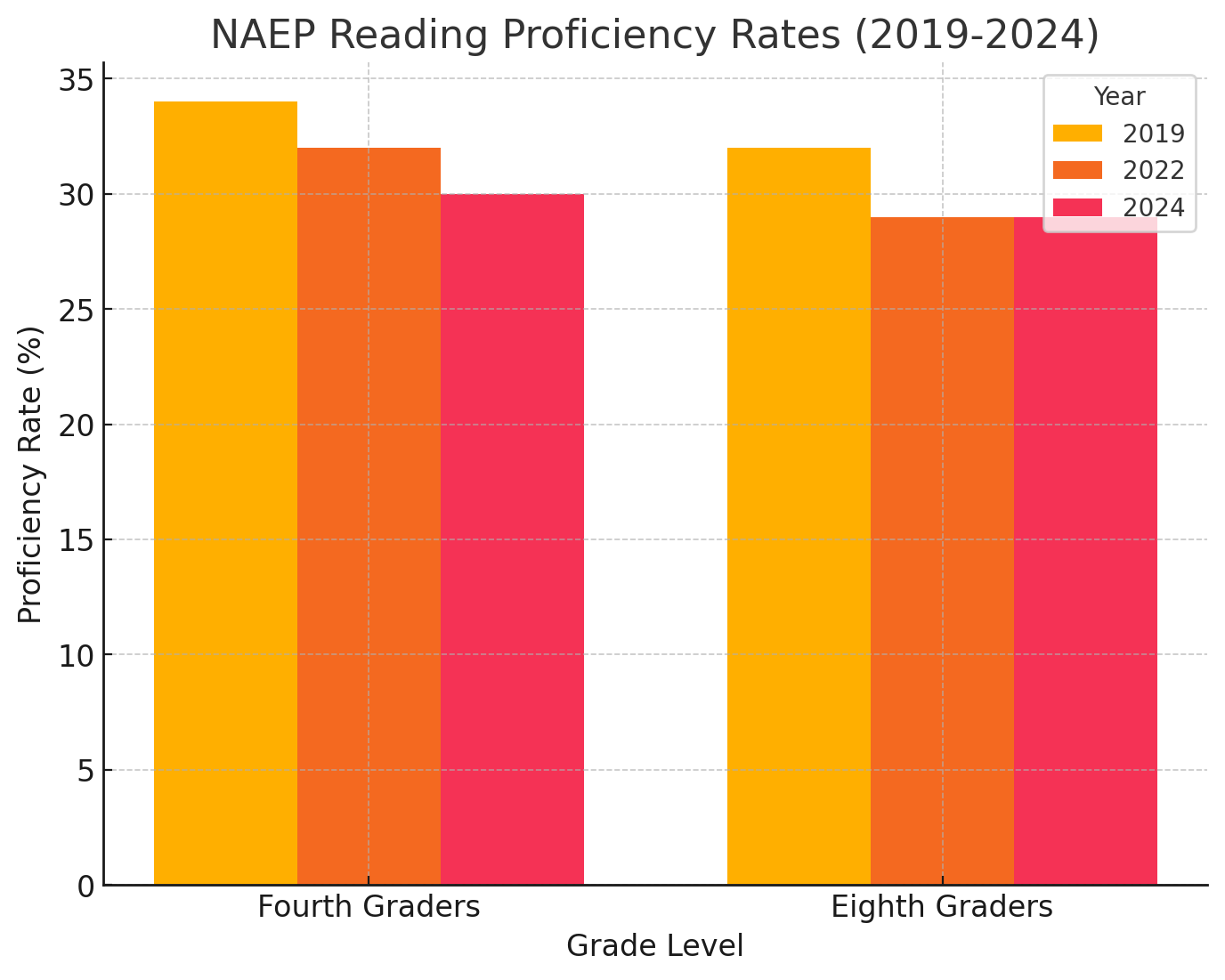
The National Center for Education Statistics recently released the Nation’s Report Card for 2024 and found that only 30% of all fourth graders and 29% of all eighth graders nationwide scored at or above proficient in reading.
However, the results are worse among Black students: Only 17% of Black fourth graders scored at or above proficiency — a percentage that hasn’t improved since 2022 and is worse than a decade ago. And Black eighth graders currently have a 14% proficiency rate — down from 15% in 2022.
Let that sink in: In 2024, when AI can write your essays and TikTok University can teach you practically anything, schools are still failing to ensure a majority of Black children learn one of the most fundamental skills.
“This data is alarming,” says Dr. Artika Tyner, founder of the Planting People Growing Justice Institute, a Minnesota-based nonprofit dedicated to social change and promoting reading and diversity in literature.
And with these results, Black students “are at a competitive disadvantage.” Reading, she explains, is “a critical skill needed to excel not just in school but throughout their lives and future endeavors.”
A Chronic Issue
Tyner says students’ lack of reading proficiency isn’t a sudden crisis. “Reports and assessments may bring renewed relevance, but this issue is not new,” she says.
Instead, it’s more like a chronic condition that America is content to live with, especially when it comes to Black students.
In 1992, when the NAEP assessment was first administered, only 8% of Black fourth graders were proficient in reading. The early 2000s saw some improvements, but progress peaked with 18% of Black fourth graders scoring proficient or higher in 2015.
We’ve had decades of education reforms that were supposed to fix this, so what’s going on?
Dr. Aaron Pallas, professor of sociology and education and chair of the Department of Education Policy and Social Analysis at Teachers College, Columbia University, puts it plainly: “Black students are often in school districts that have concentrations of economic disadvantage or poverty. And those schools often lack the critical resources readily available in affluent ones.”
In 2021, 37% of Black students attended high-poverty schools, compared to just 7% of white students. And those high-poverty districts? They get about $800 less per student in state and local funding. That gap shows up in fewer resources, less experienced teachers, and limited access to advanced coursework.
As for the reforms — like No Child Left Behind and Every Student Succeeds — “we’ve had an overemphasis on ineffective policy interventions and less prioritization of instructional strategies,” Pallas says.
That so many kids are still not proficient “shows these interventions didn’t have much of an effect,” he explains. And “debates over the ‘science of reading,’” Pallas says, “have led to inconsistent literary instruction, especially in under-resourced schools.”
Read Well by Third Grade… or Else
And then there’s the third-grade factor.
“Students learn how to read until third grade, and then they begin reading to learn starting in fourth grade,” Tyner says.
Research from the Annie E. Casey Foundation shows that kids who aren’t reading proficiently by third grade are four times more likely to drop out of high school.
“Falling behind in literacy at this critical stage creates barriers for Black students to academic achievement and perpetuates cycles of oppression,” Tyner says.
So, What’s the Fix?
In decades past, Mississippi’s NAEP reading scores hovered near the bottom. This year, however, the state had the third-highest percentage of Black fourth graders scoring at or above proficiency. Experts chalk the improvements up to a state law passed in 2013 that mandated phonics instruction and mandatory retention for third graders who couldn’t read fluently.
Others, like Mississippi Sen. David Blount, D-Jackson, pointed out that improving students’ reading had become a non-partisan issue in the state.
“Democrats and Republicans have pushed for more reading coaches to help students who had fallen behind and more career coaches,” Blount told the Mississippi Free Press. “We passed a new funding formula that increases funding with greater equity. We have been working together.”
It will take more than just throwing money at the problem (though let’s be clear — more funding for schools wouldn’t hurt.) And Pallas says the solution “isn’t just about policy changes but more about ensuring every child has access to high-quality literacy instruction.”
Tyner also advocates for recruiting more Black teachers, making federal investments in early childhood literacy, expanding teacher training around biases, and training educators in strategies to help support reading at home can also help.
“Literacy is something that gets acquired both in and out of school,” Pallas says. “Parents and families reading to their children and fostering a culture of literacy outside of school can make all the difference.”
And as Tyner asks, “Would you build a house without a foundation and expect it to stand?” She says literacy “provides a solid foundation for learning and critical thinking, and we need to create environments where learning happens everywhere — at home, in libraries, churches, and community centers.”
This story was originally published online with Word In Black, a collaboration of the nation’s leading Black news publishers (of which The Informer is a member).
