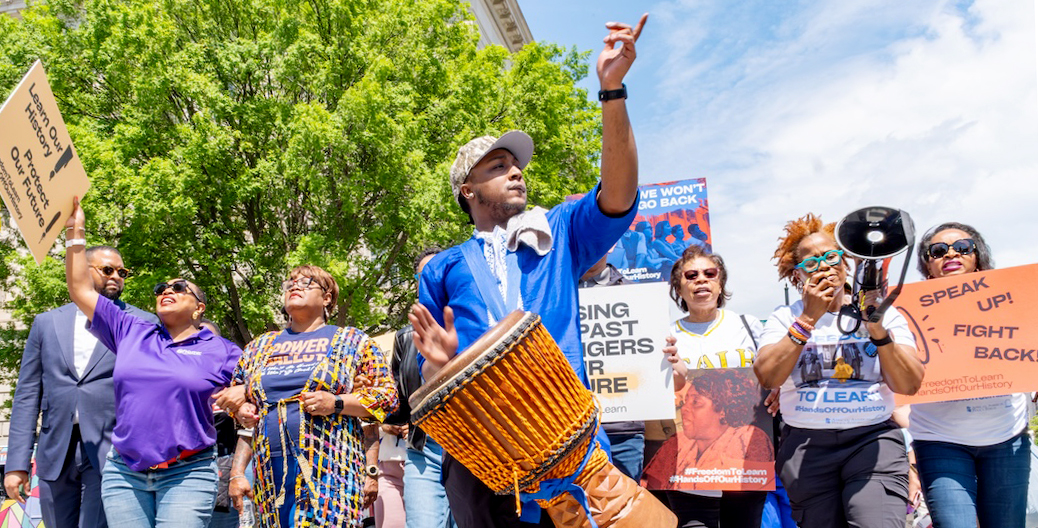
When final ballots are cast Nov. 3, the hope is to see a reversal of the election where more than 90 million people failed to vote in 2024.
From eliminating disenfranchisement to dispelling trends against civic engagement, civil rights and religious leaders are at the center of a national plea to restore faith in democracy.
More than that, the Rev. Lennox Yearwood Jr. says this midterm marks a pivotal time to reignite a fire in the generations holding America’s future in the palm of their vote, whether they realize it or not.
“What I want this generation to understand is that this is your fight more than ever,” Yearwood, president and CEO of the Hip-Hop Caucus, told The Washington Informer. “We’re dealing with an enemy who wants to destroy us, whose business plan means a death sentence for our communities…We got to be much more serious. Our genius, our excellence, must show up now to do everything we can, to literally fight for our lives.”
While organizers focus on increasing voter turnout, fusing culture and strategy seems to be an asset for the faith leaders aiming to amplify youth voices and foster renewed hope.
Recent data from the Black Opps Coalition show that crucial rollbacks on civic protections, including the Supreme Court decision to gut the Voting Rights Act in April, have made for an activated, albeit hopeless Gen Z — which evidently makes up 50 million of eligible voters in 2026, according to the Feminist Majority Foundation.
Coupled with legislative controversies like housing and energy bills, Yearwood said the call to democracy is just as pertinent as the ones “our parents” fought, and so is the task to center cultural influence in pursuit of “a roadmap to freedom.”
“Our schools, our hospitals, our barber shops … even our funeral homes — we’ve been able to do all that through our culture. When we didn’t have food, we made food happen. When we weren’t allowed to have fun…we made Black joy happen,” the CEO reminded. “We’ve always used our culture for freedom, and so I think we must use it now, particularly in some cases, to do things in code.”
That code can look like anything from launching the largest and longest-running hip-hop voter campaign in history to local pastors uplifting communities through principles of faith.
With Election Day less than a week out, efforts to reach those often sidelined at the polls come through letting “the culture” do the talking, starting with empowering those that define it.
“We’re definitely, without a doubt, still fighting for equality now, but we’re also fighting for existence in the 21st Century,” Yearwood said, before emphasizing the importance of engaging in local and general elections. “We can vote for the governors that are pushing [policy]; we can still vote for the numerous members of Congress in office. That’s why this generation and [their] voice is so important.
Not only is America watching, but the whole world is.”
Campaigns, Culture and the Formula to Freedom
Four months before the U.S. would elect its first Black president, the Hip-Hop Caucus established a foundation to ensure voter participation became synonymous with African American culture.
With the launch of the nonpartisan Respect My Vote campaign in 2008, Yearwood laid the groundwork for generations to leverage hip-hop as a mouthpiece for civic participation, all the while reclaiming what it means to “meet voters where they are.”
Eighteen years, and some critical rollbacks on civic protections later, the CEO emphasized that mobilizing for midterms is not a matter of fulfilling civic or ancestral duty, but a call to change the modern suppressive tactic that aims to “beat [voters] down.”
“Those who don’t feel like they’re part of the American dream, who don’t feel like they have a voice in this democracy…we’re educating, we’re mobilizing, we’re energizing them to get out,” Yearwood continued, “to know that their genius is needed, their wisdom is needed, and to make America better, honestly, they are needed.”
In its 18th year, Respect My Vote is campaigning on a four-pronged goal: reach 20 million people, mobilize 500,000 to the polls, make 4.5 million voter contacts, and generate 175,000 online voter registrations, voter pledges, and registration checks.
While working in key states — such as the Deep South, Michigan, Ohio, and several others — the movement examines the power of culture, media, partnerships, and digital engagement to advance justice and community-driven solutions through voting.
“My mom and dad looked at Harry Belafonte and Eartha Kitt and Dick Gregory. For me, I’ve worked with artists from T.I. to Keke Palmer within the early days of the campaign. This new generation…how do you use your influence?” Yearwood posed.
He then highlighted the new-age culture of social media, where influencers from Howard University students to the most celebrated household names can engage thousands of followers across one platform to effect change.
DMV native, the Rev. Nathaniel “Nate” Douglas credited this tool as the focal point of today’s voting movement: political agitation and the “responsibility” of creators to use it to engage youth.

“When you become a political agitator, you become more aware and more conscious of everything that’s happening around you, and that is what influences people to vote in the right direction,” said the senior pastor of Seven Mountain Ministries in Laurel, Maryland. “A lot of our artists don’t even realize that they are political agitators — they have the power to provoke thought. And it’s no better way to provoke thought than through song, through rhyme.”
Douglas, a veteran of merging performing arts and ministry, cited cultural expression as not just a way to attract young minds, but also to evolve the landscape in which African Americans assume power — and even garner a better understanding of God’s.
Reflecting on what once stood as “testimony music,” in his words, the 46-year-old pointed to the origins of hip-hop as a prime example of creatives serving as powerful influences in social and political progress, from uniting African Americans with meaningful directives to reminding them of the strength in their roots.
“Once [people] get that sense of identity, there are no limits at that point. They walk in these streets…with their head held high, knowing that every decision they make represents the people whose shoulders they’re standing on, and it represents their future children,” he told The Informer.
When he isn’t inspiring residents with music, free resources and the word of God, Douglas’ political agitation looks like working on behalf of the Black Men Agenda, a nonpartisan motion by Million Man Vote to address societal injustice against African American males.
Further, he adds, in order to reach overlooked demographics and youth voters alike requires action that is as consistent as it is deliberate — plus coming to terms with an unwavering truth: “people don’t care how much you know until they know how much you care.”
“It starts with the love of God, and it starts with being consistent and deliberate about giving that to people. And then you create a space where you can create that paradigm shift,” Douglas said. “The [churches] that are doing it right are the ones listening to their youth, empowering them, giving them true mentorship. … If we stick to that formula, then we’ll continue to see a lot more … as far as civic engagement, through music and…support from faith-based organizations.”
Final Push to Midterms — And Then Beyond
With all eyes on fueling a pivotal outcome, faith leaders say the plan is to campaign right through Election Day next week — and even well beyond that.
In its final throes of the countdown, the Hip-Hop Caucus is continuing to elevate the power of the culture, including hosting the Respect My Vote National Organizing Rally on Oct. 27 at 7 p.m. EST, featuring singer/songwriter and celebrity spokesperson Shelby J, and participating in Word in Black’s virtual Know Before You Vote event on Oct. 28.
After that, the civic activist told The Informer that midterms are just the beginning of the work for the Hip-Hop Caucus, noting the process is a marathon, “not a sprint.”

“We can’t just vote in November and then not come back to this. [We’re] going to keep moving forward, keep organizing our people, keep being on the college campuses, keep being in the hood,” Yearwood assured. “The Bible says that God will use the foolish things to confound the wise, and sometimes what is foolish to others is actually your roadmap to freedom. I think that culture has been the one.”
In Northeast Washington, the Point DMV Church has been at the forefront of expanding voter information. Piggybacking on the newly-formed “Summer Rhythm,” senior pastor, the Rev. Dr. O. Jermaine Bego, said the faith institution continues to host events and resource tables across the region, including voter registration drives and other opportunities to educate the public on “the consequences that are before us.”
“A lot of our congregations are not what they used to be when you look back at the Civil Rights Era, but we still have an active presence and a power that we can bring to this fight,” Bego told The Informer in September. “Rallying our churches, our congregations, our denominations, and putting boots on the ground. I believe that we can do a better job…to be on the front lines.”
As for the role of youth, Douglas encouraged young voters to use the midterm elections as a launchpad to elevate their own purpose, or seek “a new thing” God is calling them to do.
In the meantime, he hopes to see all faith leaders exactly where they should be between now and Nov. 3 — in the streets, on the grounds, “attracting these young people to you.”
“If you want to have an impact within the next [week], I suggest you get your bullhorn, get your colored pamphlets, get some nice hip-hop music, and get out in the streets,” Douglas told The Informer. “Pull up with your information, pull up with your resources, pull up with your bait. Get loud, get active, and be ready to educate.”