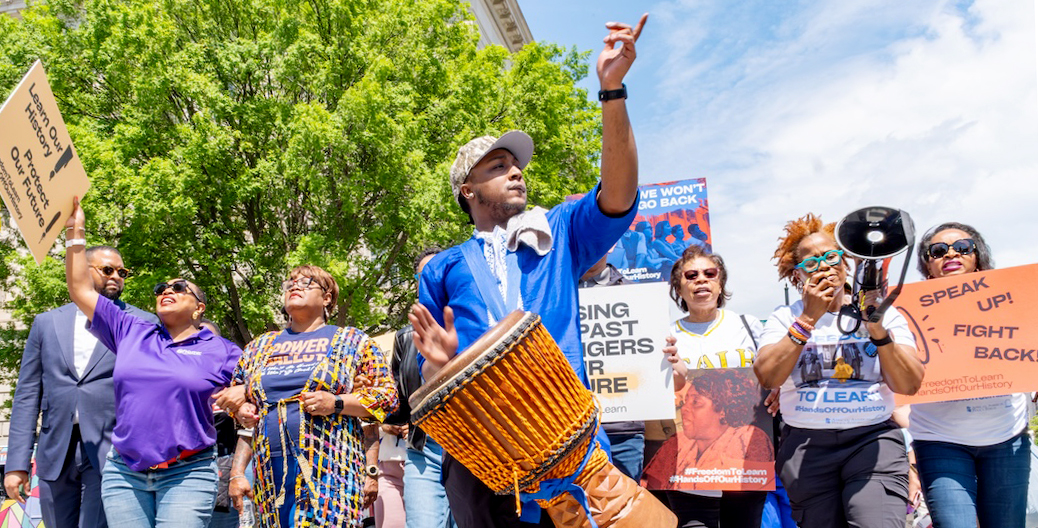

More than six decades after courageous young activists boarded buses in Washington, D.C., to challenge segregation in the South, a new generation of Freedom Riders is taking off on a journey of their own to remind Americans that the struggle for equality, justice and democracy is far from over.
The Ride — a national bus tour turned feature documentary — is a 12-day, eight-state journey that broadly retraces the 1961 Freedom Ride route through Virginia, the Carolinas, Georgia, Alabama, Tennessee and Mississippi to New Orleans — where the original riders, stopped on the road by mob violence in Alabama, ultimately had to arrive by plane.
The modern-day Freedom Ride, running from Oct. 17-28, began at the historic Metropolitan African Methodist Episcopal Church in downtown D.C., bringing together civil rights activists, their descendants, clergy and community leaders to reflect on sacrifices of the past and the challenges confronting the nation today.
“The original Freedom Riders understood something we must never forget: laws do not enforce themselves,” said the Rev. Dr. Traci Blackmon, who led a conversation with Metropolitan AME lead pastor, the Rev. Dr. William H. Lamar IV. “Justice does not advance simply because we believe in it, and democracy does not defend itself.”

Organized in collaboration with Vote Common Good and Faith Out Loud!, the journey retraces the historic 1961 Freedom Rides with stops at churches, historically Black colleges and universities (HBCUs), and civil rights landmarks from Washington to New Orleans.
More than a revival, the multistate trek reflects a broad coalition continuing a commitment of African American organizations to civic engagement, community service and the preservation of civil rights history.
“We are seeing a concerted assault on our freedom to vote and on our very democracy itself…[where] we are faced with the question of: what we will do? And this freedom ride…remind(s) us,” said a representative of the co-sponsor organization, Sojourners.
Members of the O-Six Ryderz MC — the first “sanctioned” Motorcycle Club founded by and exclusively for members of Alpha Phi Alpha Fraternity, Inc. — announced they would accompany the Freedom Bus on its journey to Louisiana, an effort to connect the historic courage of the original Freedom Riders with a contemporary call for collective action.
While not every motorcycle rider would travel the entire route, club representatives noted that additional riders would join the caravan along the way, including stops in Charlotte, Georgia, Alabama and Tennessee, to name a few.
“We want to make sure that people understand that these freedom riders of the 21st Century are not riding by themselves, and that this is a new day,” one O-Six Ryder told the crowd on Oct. 18. “In this moment, we’re going to ride.”
Further, the message of the day was unmistakable: Freedoms secured through sacrifice must be defended by every generation.
“We must remember that the chain of freedom does not begin with us; that chain of freedom reaches back to our ancestors and lunges forward toward our descendants,” said Blackmon, paraphrasing human rights activist Dr. Loretta Ross. “Our only task is to make sure that chain does not break on our link. That’s why we’re here.”
A New Generation Takes the Road
The contemporary Freedom Ride includes approximately 22 events along its route, all moving to reclaim the spirit of those who believed America could become a more inclusive nation, according to Vote Common Good’s Doug Pagitt.

“We are a better nation when the ‘we’ gets larger and larger,” said executive director Pagitt. “If we want to say ‘we, the people’ in this country, we have to expand that ‘we.’ … We are proud to be in this action. We are proud for our faith to be out loud.”
The Rev. Dr. Michael Waters, who helped initiate the project, urged participants to transform historical remembrance into meaningful action, particularly by voting and encouraging others to participate in elections.
Meanwhile, Bishop Mariann Edgar Budde of the Episcopal Diocese of Washington offered prayer and calls for safety and peace at the former Greyhound bus station in Washington, where the original Freedom Riders began their historic journey south in 1961.
As the buses and motorcycle riders prepared to depart, attendees were reminded that the Freedom Rides were never simply about access to buses, lunch counters or airport terminals; they were about the fundamental right to see every American treated equally.
And 65 years later, that journey continues.
“We are in the city of Washington, D.C.: a city where the most powerful lawmakers in the world gather, and we want them to hear the voices of the people here today and to hear the voices of those who stood at this space 65 years ago,” Pagitt declared, “that we will not rest until all can be included in this nation.”
A Church Rooted in Freedom
Metropolitan AME, often called America’s Freedom Church, provided a fitting setting to launch a historic rendition of the 1961 Freedom Rides.
Lamar reminded attendees that the historic congregation has served as not only a place of worship, but a center for education, political organization, cultural expression and the advancement of African American liberation since the 19th century.
“Our ancestors saw themselves to be more than what the United States saw them to be,” Lamar said, reflecting on the church’s architecture and history.
He challenged the audience to confront systems that perpetuate inequality, arguing that the Black church must continue its tradition of social and political activism.
“We must build something for everyone,” said Lamar.
He also urged Black Americans to evaluate elected officials by their commitment to justice and the needs of ordinary people.
“We too often give a pass to Black politicians and Black preachers because they are Black, the same way Trump is trading on whiteness with everything he says and does,” Lamar explained. “My argument is that we must hold ourselves [Black politicians] accountable and speak to the world and organize and build the power to make this a democracy.”
Remembering Those Who Rode
Among the gathering’s most compelling moments were firsthand accounts from participants in the Freedom Rides.
The Rev. Alphonso Petway recalled how the 1955 murder of Emmett Till awakened his determination to challenge racial injustice. As a young man, Petway participated in a Freedom Ride that tested segregation practices in air travel.
His sister, Krendelle Petway Dendy, described being refused service at an airport lunch counter in Montgomery, Alabama, before boarding a flight to Jackson, Mississippi.
Upon arrival, she and fellow activists were arrested and transported to the Hinds County Jail, where she spent three days.
“It really didn’t become a reality until that door to that jail cell slammed,” she recalled.
Phillips described the fear experienced by her family and the lasting consequences of her arrest, including complications when applying for federal employment years later.
Despite those experiences, she emphasized the importance of voting and civic participation.
“We need to wake up, stay awake,” she said, urging Americans to remain vigilant about their voting rights.
Robbie Thomas, daughter of original Freedom Rider Hank Thomas, represented another important link to the movement’s legacy.
Her father, then a student at Howard University, was among the original 13 Freedom Riders who departed Washington on May 4, 1961, helping launch a movement that challenged segregation in interstate transportation and exposed the violence used to enforce racial discrimination.
Thomas recalled learning years later about the dangers her father had faced.
“Most people would probably assume that from the time I was old enough to talk and walk, that we were told about the wonderful sacrifices that Freedom Riders made and that I had been hearing stories about these rides all of my life,” shared Thomas. “But unfortunately, that is not the case because for those persons participating in these rides…it was not celebratory. It was not anything they shared.”
For those young activists, she explained, participation was not a celebrated achievement but a potentially deadly commitment. Before beginning their journey, they prepared wills, cognizant that they might not return.
“I thank you guys for allowing us to recreate this wonderful ride, and to be able to share with all of those along the way exactly the sacrifices that were made by each and every individual that was a part of this ride,” Thomas continued, “and I thank you for allowing me to participate in standing in the gap for my father.”